
.png)
India has one of the world’s largest fibre backbones, but the last mile remains the most expensive, slowest, and hardest part of the network to build. While fibre powers the core network, last-mile connectivity often depends on alternative technologies. This blog explains the trade-offs, costs, and what the data says about solving the last-mile challenge.
The Big Picture
India’s last-mile connectivity currently relies on four major technologies: Fibre, Microwave, mmWave(E-band) Radio, and Unlicensed Band Radio (UBR). However, rising challenges are pushing operators to explore newer alternatives. Velmenni’s Optical Wireless Communication (OWC) offers a cost-effective and reliable way to connect the last mile without heavy civil or spectrum-related constraints. Understanding where each technology fits and what each truly costs enables smarter last-mile infrastructure decisions for the operator.
The Last Mile Gap
In dense urban zones, enterprise campuses, and smart infrastructure, existing connectivity technologies come with operational trade-offs.
Fiber deployment remains slow and expensive due to trenching, civil work, and multi-agency approvals, while microwave and mmWave deployments still rely on capability to deliver desired capacity and distance while operating in scarce-spectrum conditions. In dense urban environments, limited physical space further restricts infrastructure expansion without major disruption.
At the same time, AI, cloud, and high-bandwidth workloads are increasing faster than traditional networks can scale. Microwave signals, considered the workhorse of wireless, are severely constrained by spectrum for high-capacity backhaul. Although E-band(mmWave) can provide a high capacity backhaul, their performance is compromised over longer ranges(typically more than a kilometer) and during bad weather. UBR solutions, which were seen as a cheaper alternative to scale the network, often struggle in congested RF environments due to interference, which is why they are unreliable in assured SLA zones.
As network density grows, scalability and maintenance become increasingly difficult across all technologies. Fibre expansion requires repeated civil work and physical relaying, while microwave, mmWave, and UBR networks face spectrum and interference limitations. Frequent outages also demand costly backup infrastructure, and maintaining both fibre and wireless networks continues to require significant operational manpower and energy consumption.
Considering these challenges, fibre is becoming less practical for many last-mile deployments, where time-to-market is the key. While newer wireless alternatives are emerging as faster, more scalable, and operationally efficient solutions.
Last-Mile Connectivity: TCO Perspective
When the going gets tough, wireless technology gets going.
To solve the last-mile challenge, operators today increasingly rely on wireless technologies such as Microwave, mmWave, UBR, and the latest emerging alternative, Optical Wireless Communication (OWC).
The real comparison comes down to two questions:
• How much does it cost to deploy?
• How much does it cost to operate?
Cost To Deploy
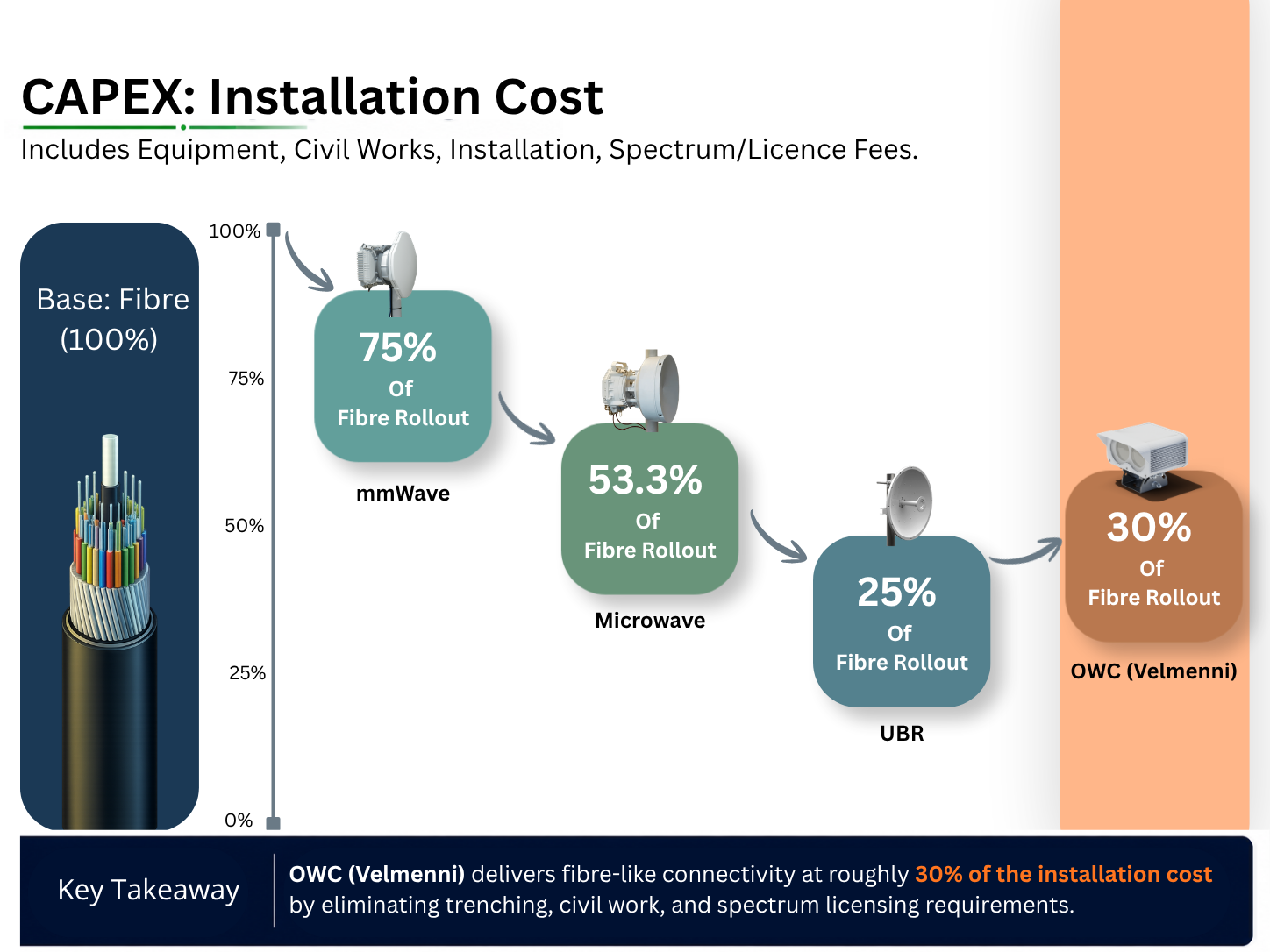
Analysis: If an operator chooses to deploy OWC solutions, then it saves nearly 30-40% of Capex when compared to mmWave and Microwave.
mmWave and Microwave involve significant equipment, tower, and spectrum-related costs. OWC eliminates civil work and spectrum licensing entirely, enabling the fastest deployment with significantly lower installation cost. While UBR appears cheaper initially, its operational limitations and recurring maintenance overhead quickly reduce the cost advantage over time.
Cost To Operate
OPEX: Yearly Operating Cost depends on: Power Consumption, Site rental, Remote Maintenance, Annual Maintenance Contract, Site visits and Replacements(in case of equipment failure), Spectrum renewal
Scenario: 1-2 km | 1 Gbps | Dense Urban Setting (minimum time to market and maximum availability) | 99.999% Availability
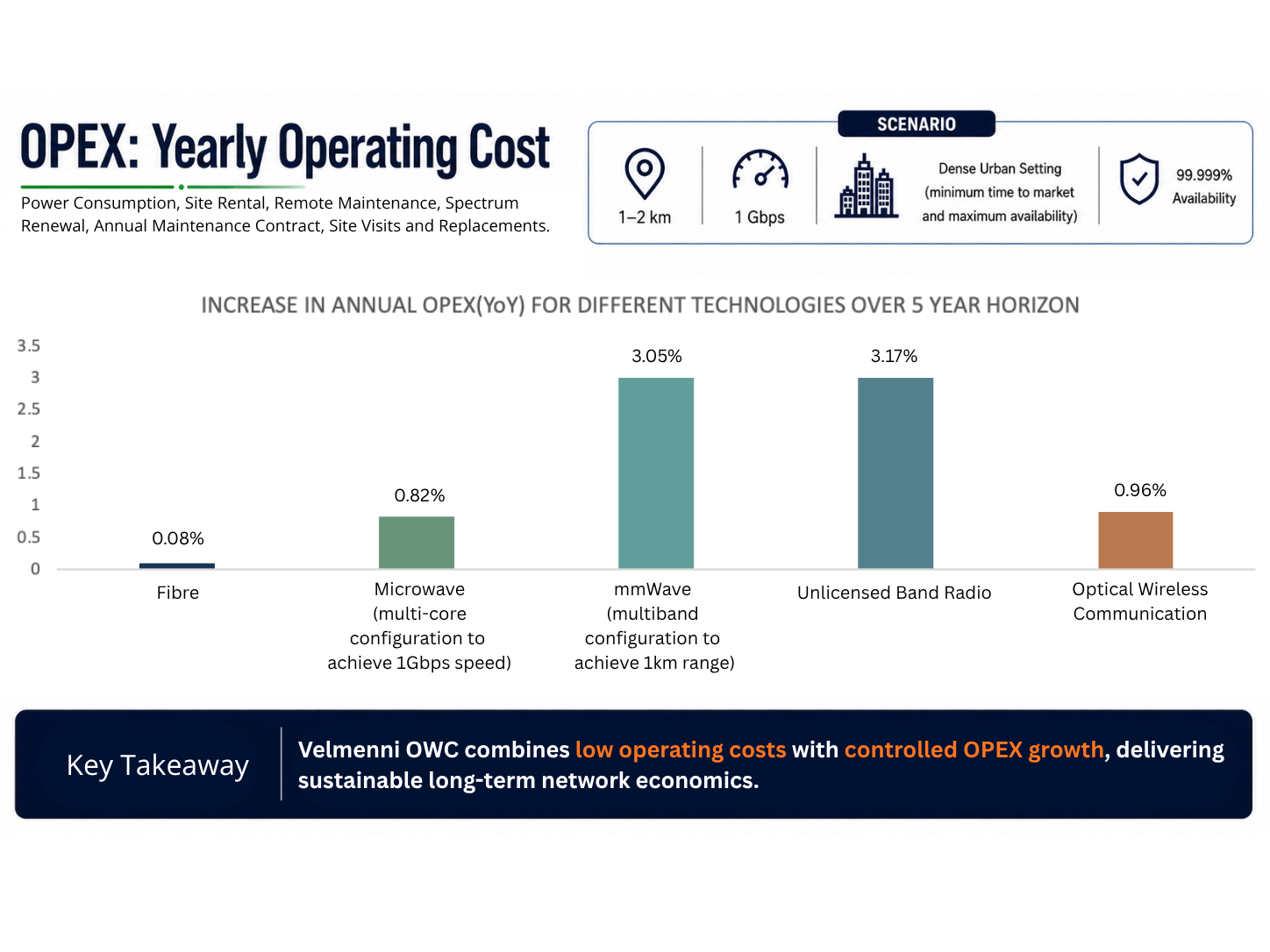
Key takeaway: Velmenni’s OWC incurs the lowest upfront cost along with lowest rise in annual AMC in a dense urban environment where time-to-market and low-cost reliable service is a critical factor.
- Microwave. Although, the percentage share of annual maintenance across other technologies declines gradually but it remains expensive due to recurring spectrum charges. Extra cost is incurred to provide higher-capacity backhaul in today’s digital era.
- mmWave. High spectrum costs, alignment sensitivity, and weather exposure keep the annual bill consistently high.
- UBR. Starts lean but climbs every year, becoming the most expensive wireless option after a 4 to 5 year horizon. Device changes after 3rd year, adds to the network maintenance cost.
- OWC. Alongside having the lowest annual maintenance bill for the first year, it also has one of the lowest increases in that bill YOY. Optical wireless has the lowest OPEX among all wireless technologies across the entire window. Plus there is no spectrum related expenditures.
As observed, OWC combines a low entry cost with a low operating cost curve. As Velmenni plans to scale the OWC networks across dense urban cities, it plans to bring the OPEX further down.
How Optical Wireless Communication Changes the Economics
OWC fundamentally changes the cost, speed, and scalability equation of last-mile connectivity.
Key Value Propositions include:
- Faster Deployment – Go live in hours, not months.
- Lower CapEx – Eliminate trenching and costly civil works.
- Quicker Revenue Realization – Activate services and generate revenue faster.
- Future-Ready Capacity – Multi-gigabit performance with room to scale.
- Zero Spectrum Costs – No licensing fees or regulatory burden.
- Reduced OpEx – Minimal maintenance and fewer site visits.
- Rapid ROI – Payback in months rather than years.
- Flexible & Scalable – Ideal wherever fiber is costly, delayed, or impractical.
Why Velmenni
Velmenni’s OWC technology is a purpose-built technology for scenarios where existing last-mile solutions become difficult to perform.
- Scalability: Add capacity by upgrading the terminal, not digging or re-licensing. Scales in hours.
- Flexibility: Links can be repointed, relocated, or removed the same day. No fixed infrastructure left behind.
- Reliability: All technologies modelled to 99.999% availability. OWC achieves this through adaptive modulation and hybrid configurations.
- Weather: Dense fog can affect OWC at longer distances. Rain has limited impact. For most urban links under 1 km, the link budget absorbs fog and rain challenges without availability loss. In fog-prone zones, a hybrid OWC and Microwave enables the desired availability targets.
- Regulatory Dependency: No spectrum licence, no SUC charges, no AGR exposure. Microwave and mmWave carry all three, plus policy risk over five years.
- Sustainability: Lowest power draw of any wireless option at 0.01 kW per site. Lower energy, lower carbon footprint, lower electricity bill.
Conclusion
Velmenni connects environments where traditional last-mile technologies become too expensive or too slow to deploy, including dense urban corridors, factory campuses, defence sites, and smart city infrastructure where trenching is impractical and RF performance becomes unreliable. With deployment timelines measured in hours instead of months, Velmenni gives operators a strong commercial advantage in markets where speed of delivery directly impacts revenue generation. At the same time, its long-term cost curve continues to improve as spectrum costs rise, civil work becomes more expensive, and data demand grows rapidly year after year. A technology whose operating costs reduce over time is not just commercially attractive, but strategically essential for the future of last-mile connectivity.


